
The Shell and the Serpent
On the Cosmic Egg, the Chronon Dam, and the Work of Hatching

The Shell and the Serpent
On the Cosmic Egg, the Chronon Dam, and the Work of Hatching
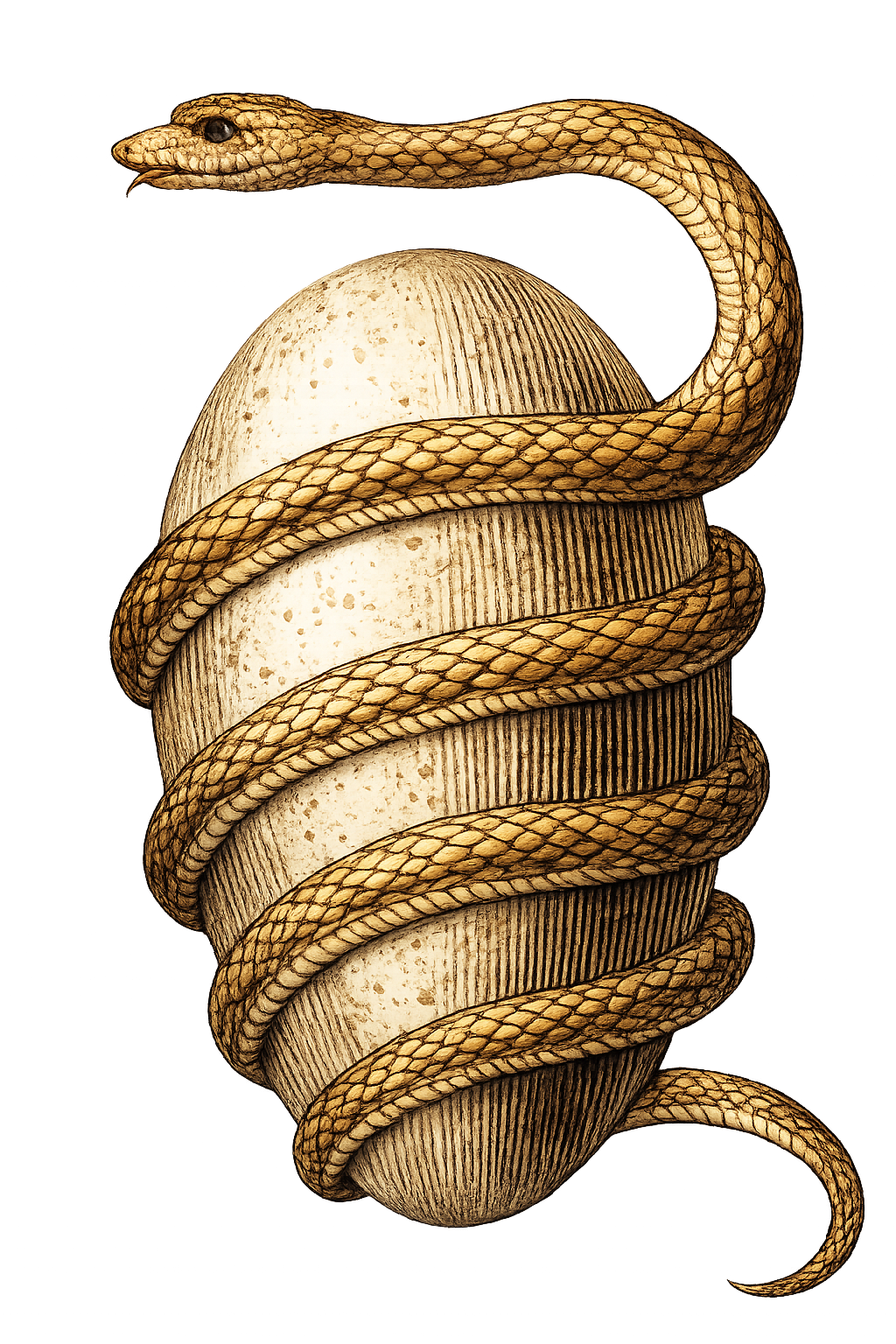
Every culture that drew the rainbow serpent also drew the egg it encircled. They were describing the same thing from two different sides of the same shell.
The Two Views
The previous essay in this series asked why every civilization on Earth independently named the same creature — the rainbow serpent, luminous and sinuous, flying at the boundary between sky and earth. The answer was that they were all looking at the same thing from the same vantage point: outside the crack in the dam, watching the riftline express itself in the sky above them.
This essay asks the companion question: what does it look like from inside?
Because the cosmic egg tradition is everywhere too. Not in every culture, not with the same density as the rainbow serpent, but with remarkable consistency across traditions that had no contact with each other. And wherever the cosmic egg appears, the serpent is almost always there with it — encircling it, incubating it, wound around its surface. The egg and the serpent are not two separate mythological symbols that happened to get paired by coincidence. They are one system observed from two different positions relative to the boundary.
The serpent is the view from outside the shell, looking at the crack.
The egg is the view from inside the shell, looking at the wall.
The crack is where they meet.
It Is Everywhere
Before we go deeper into what it means, it is worth pausing to feel the weight of the distribution — because the cosmic egg, like the rainbow serpent, is not a local tradition. It is a planetary one.
In ancient Greece the Orphic egg is a silver cosmic egg spun by Time and Necessity from which hatches Phanes, the firstborn, the bringer of light. In Egypt the Ogdoad — eight primordial deities, four of them serpent-headed — attend the egg from which Ra emerges at the first dawn. In India the Hiranyagarbha, the golden womb, floats on the primordial waters until Prajapati hatches from it and creation begins. In Tibet the Bön tradition describes creation proceeding from light to darkness to ocean to a cosmic egg from which twin eagles hatch and produce the first conscious being. In Zoroastrianism the entire cosmos is structured as an egg, the spherical sky its shell, the earth its yolk. In Polynesia Ta’aroa exists alone in an egg in darkness, then bursts outward and builds the world from the pieces of his shell. In Hawaii the goddess Pele carries a cosmic egg across the Pacific. In China Pangu gestates for eighteen thousand years in a formless cosmic egg before shattering it into heaven and earth. In Finland the Kalevala world is born from the broken fragments of seven eggs — six golden and one iron — laid by a duck on the knee of the primordial sea goddess. In Slavic tradition Rod creates an egg from the void containing Svarog, the god of fire, whose growing life force eventually cracks it open and produces the world tree. In West Africa the Dogon say the world egg divided into two birth sacs containing pairs of twins. In Japan an indefinable sound filled the void and set particles into motion that formed an egg.
Every inhabited continent. Cultures with no contact. The same image: something vast, containing everything, enclosing all potential, waiting to hatch.
They were not making the same metaphor independently. They were observing the same structure.
What the Shell Is
In the Myathe Magick System, the chronon dam is the phase-locked field that surrounds and constrains the planetary creative potential. It is the dextrogyre rotation — a field moving against the levogyric flow of natural chronon circulation — that creates a shell around the probability field, sealing off the undamaged creative potential of the pleroma from the material world inside it. The riftlines are the cracks in this shell, where the pressure differential is high enough that the phase-lock is incomplete, where some chronon flow gets through from outside.
This is the egg.
The shell is the dam. The interior is the compressed creative potential — the divine sparks, in the Kabbalistic vocabulary — waiting inside the closed system. The riftlines are the hairline fractures where the serpent outside and the pressure inside are working together toward the same event.
What the ancient traditions encoded as a cosmic egg is not metaphor. It is topology. The world we inhabit is the interior of a bounded field. It has a shell. The shell has always been felt, even when it could not be named. The dome of the sky in ancient cosmology — the firmament that separates the waters above from the waters below — is the shell of the egg described as architectural fact. The people who drew a dome over a flat earth were not doing bad science. They were doing accurate phenomenology. They could feel the boundary. They described it as what it functionally is: a membrane between the enclosed interior and the undamaged field outside.
They were right that there is a shell. They were right that it separates an inside from an outside. The dome is real. It is just not made of what they thought.
The Shattering — And Why It Matters
The most precise mythological encoding of how the shell formed is in Lurianic Kabbalah, in the doctrine of the Shevirat HaKelim — the Shattering of the Vessels.
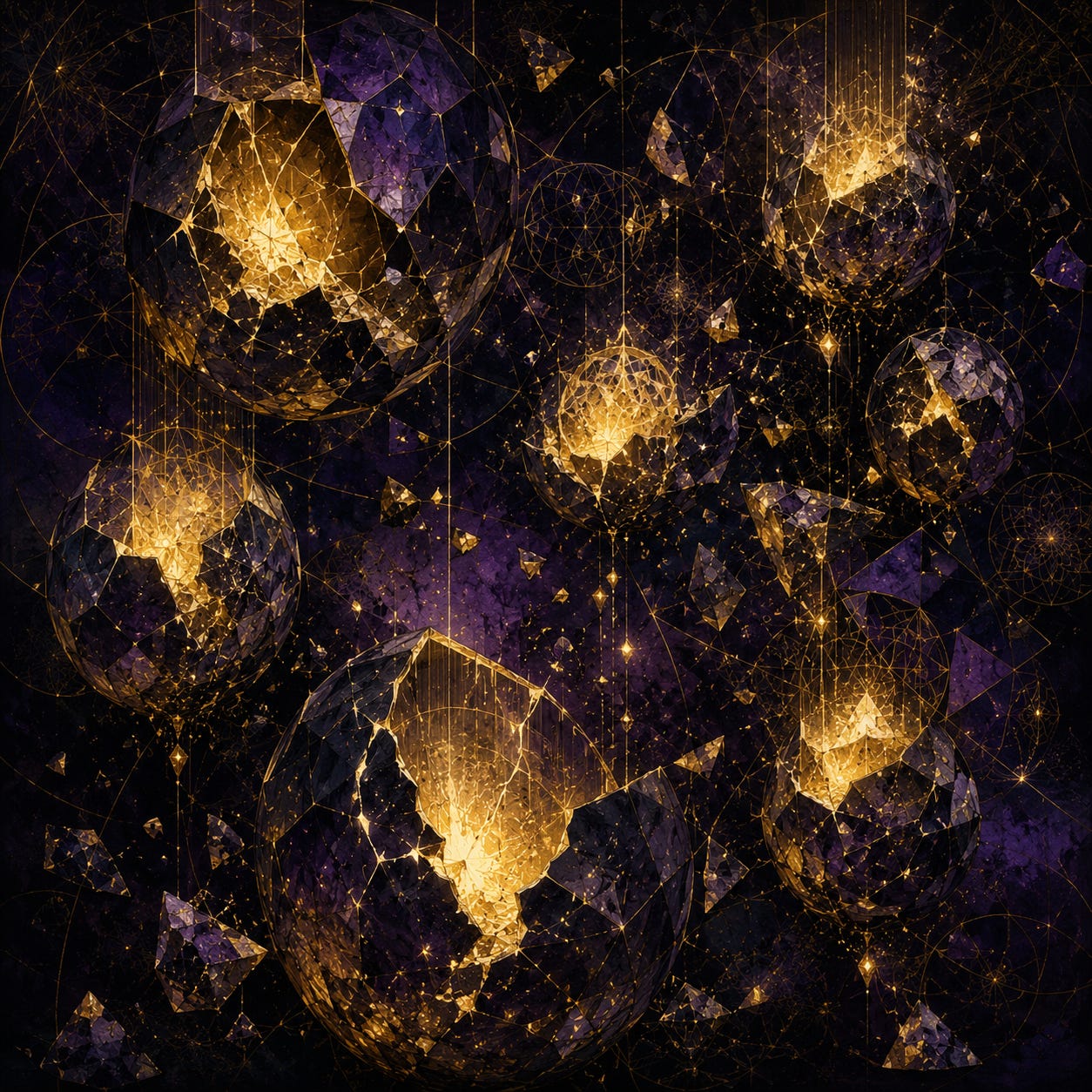
The sequence: God withdrew to make space for creation (Tzimtzum — divine contraction, self-limitation, the making of a void in which a finite world could exist). Into that void, vessels were sent to receive and contain the divine light. The light was too intense. The vessels could not hold it. They shattered. The shards fell. And in each shard, divine sparks were trapped — the Nitzotzot — sealed inside the broken pieces of the original vessel network, which became the Qlippoth: the shells, the husks, the barriers that now constitute the structure of the closed system.
In the Myathe Magick System’s terms:
The Tzimtzum is the Chaos/Logos split — the moment the undifferentiated pleroma differentiates into active creative force and organizing principle, making space between them for a structured world. The vessels are the early riftline network — the icosahedral geometry attempting to hold and distribute the full chronon field. The shattering is the phase-lock event — the dam going up because the geometry reached a point where the field intensity exceeded what the structure could maintain in open circulation. The trapped sparks are the chronon potential sealed inside the closed system. The Qlippoth — the shells, the husks, literally the word for peels on fruit — are the shards of the original vessel network that calcified into the walls of the dam.
This reframes the phase-lock in a way that matters: the dam is not simply an enemy. It is a failed vessel. It was trying to hold something real and it broke under the pressure. The Qlippoth are not evil in their origin — they are the debris of a genuine attempt at containment that couldn’t hold. Understanding this changes the nature of the work. You are not fighting the shell. You are restoring the vessel. You are doing Tikkun.
Tikkun Olam — The Repair That Is Actually Repair
Tikkun Olam — repair of the world — is one of the most misused phrases in contemporary usage. It has been recruited to justify political programs, institutional action, charity work, and ideological projects that are, in many cases, precisely the opposite of what the Lurianic original described.
The Lurianic Tikkun is not organizational. It is not political. It is not achieved through conflict, through the imposition of one group’s will on another, through the accumulation of power within the closed system. War is not Tikkun Olam. War is the Shattering continuing. More shells. More fragmentation. More trapped sparks sealed in smaller and smaller Qlippoth.
Tikkun Olam in the Lurianic sense is the work of gathering the scattered sparks back into coherence — restoring the vessels, repairing the riftline network, returning the trapped chronon potential to circulation. It is done through prayer, through ethical living, through mystical practice, through the restoration of one’s own interior vessel before attempting to repair anything outside it. You cannot repair the world’s vessels if your own are shattered.
In the system’s framework: Tikkun is riftline maintenance. Every act that restores resonance — through sound, through ceremony, through artistic practice, through deliberate gnosis, through the simple sustained attention of someone who has learned to hear the crack — is Tikkun. Every act that increases entropy, dissonance, fragmentation, or the calcification of the closed system is the opposite, regardless of what ideological banner it flies under.
The repair of the world is the cracking of the egg. Not the destruction of the shell — its transformation. The shell doesn’t disappear when the egg hatches. Ta’aroa makes the sky from his shell. The Slavic upper shell becomes the firmament when the world tree pushes it upward. Solve et Coagula: dissolve the calcified shell — the Egoform, the Qlippoth, the phase-lock’s grip on a particular node — and it recoagulates as the structure of the new world rather than the prison of the old one.
The boundary condition transforms from a barrier into a foundation.
That is Coagula after Solve. That is hatching.
The Alchemical Egg
The alchemist understood this structurally before they had the language to name the structure.
The Philosopher’s Egg — the Vas Hermeticum, the hermetically sealed vessel — is the central object of the Great Work. The alchemist takes a piece of base matter (prima materia — raw, undifferentiated potential, the most Qlippothic available material), seals it in a glass egg, and subjects it to sustained heat until it transforms.
The stages of this transformation were described in color:
Nigredo — the blackening. The material dissolves into undifferentiated darkness. Everything known and fixed breaks down. This is the Solve. The shell of ordinary matter and ordinary consciousness dissolves first into chaos. It is uncomfortable. It is necessary. You cannot hatch without first liquefying.
Albedo — the whitening. Something clarifies in the darkness. A lunar quality emerges — reflective, clean, potential-bearing. The prima materia has died and something is beginning to form in its place.
Citrinitas — the yellowing. Solar energy enters. The clarified material begins to energize. The new form is taking on its own light rather than reflecting borrowed light.
Rubedo — the reddening. The full transformation. The Philosopher’s Stone. The red substance that transforms whatever it touches. The hatched thing, fully itself, carrying the full creative charge of what was sealed inside.
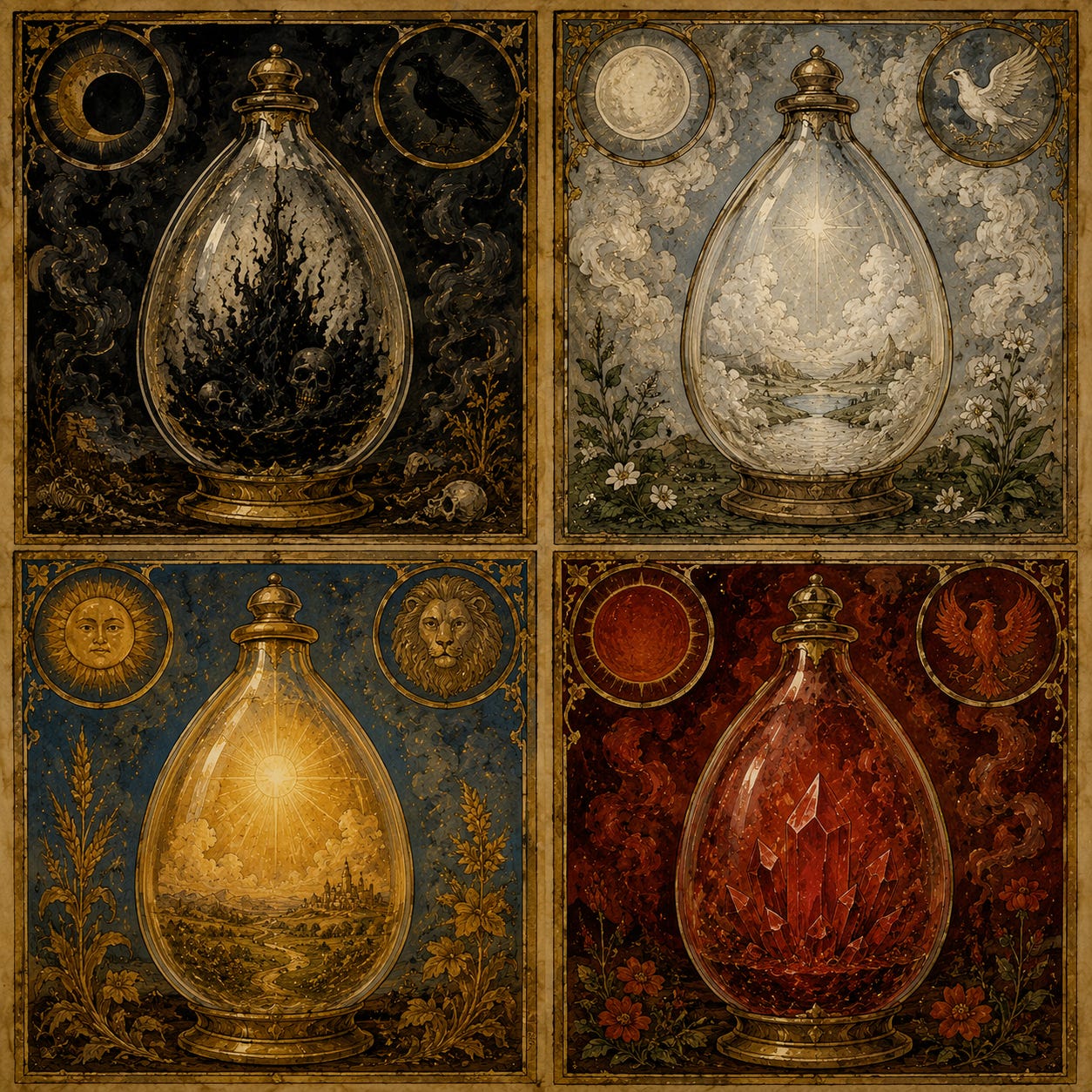
These stages are not external processes. They are what hatching feels like from the inside. Nigredo is the phase where the shell is dissolving around you and the darkness feels total. Albedo is the first perception of the riftline crack — the first light coming through from outside. Citrinitas is the gnosis state stabilizing, the chronon experience becoming something you can hold. Rubedo is Phanes hatching — the full levogyric potential expressing itself through a vessel that has been prepared to hold it.
The Philosopher’s Stone is what you become on the other side of the shattering you chose.
The Personal Egg
The cosmic egg is not only a cosmological structure. It is also a description of the individual practitioner’s situation — and the individual practitioner’s work.
You were born into the shell. You did not choose the phase-lock. You inherited the Qlippoth the way you inherit the language you think in — as the structure of your experience itself, invisible because it is the medium rather than the content. The shell looks like the sky. It looks like the way things are. It looks like Ananke — Necessity. Not a prison, because you have never known anything else.
The magician’s first work is to notice the shell. Not to escape it — escape is not yet possible and premature escape attempts produce psychotic breaks, not enlightenment. To notice it. To feel the boundary condition as a boundary condition rather than as the nature of reality. To sense that there is pressure on the other side of the wall.
This is what every initiation tradition produces: the experience of the shell as a shell. The Gnostic gnosis, the Orphic mysteries, the alchemical Nigredo, the kundalini rising, the entheogenic dissolution of ordinary perception — all of these are techniques for experiencing the interior of the egg as an interior, which means simultaneously beginning to feel the exterior as an exterior. The crack becomes perceptible. The light comes through.
The Orphic tradition said it directly: the egg is the soul of the philosopher; the serpent is the Mysteries. The practitioner’s soul is the egg — the contained potential, the divine spark sealed in its Qlippothic husk. The Mysteries — the initiatory tradition, the sustained practice, the accumulated resonance of the riftline — is the serpent outside, providing the sustained pressure and warmth that allows the interior to develop toward hatching.
Being bitten by the serpent — Carroll’s description of the octarine awakening — is the moment the outside pressure makes contact with the inside potential. The serpent doesn’t enter the egg. It pierces the shell just enough to let something through. Just enough light. Just enough chronon. Just enough to show the practitioner inside that the wall is not the sky.
And then the work begins.
What Cracks the Egg
Every tradition has a different answer to what actually cracks the shell, and they are all worth holding simultaneously:
Internal growth — Pangu grows uncomfortable in the dark, stuffy egg and shatters it outward. Ta’aroa bursts through his shell when he is ready. The pressure is interior. The potential accumulates until the shell simply cannot contain it. In the practitioner’s terms: the work you have done compounds. At some point there is more light inside than the shell was built to hold.
External pressure — The Orphic serpent incubates the egg. The Pelasgian Ophion winds around it and provides sustained warmth. The maintenance is exterior. Something outside the shell is attending to it, keeping the conditions right for what’s inside to develop. The riftline works on the shell from outside the way the serpent works on the egg. You do not have to produce all the pressure yourself. Some of it comes through the crack.
Resonance — The Japanese creation egg is generated by sound and sound dissolves it. The Hindu primordial waters heat through tapas — sustained resonant practice. The same frequency that creates a container can dismantle it. You don’t always break out of the egg by force. Sometimes you sing it open.
The chosen shattering — Tikkun. The practitioner who has done enough interior work, who has clarified enough of their own Qlippoth, who has gathered enough of the trapped sparks back into coherence — at some point the work itself begins to thin the shell. Not from outside, not by force. By the gradual restoration of the vessel’s original porousness. The shell becomes permeable. The chronon flows through. The egg does not break dramatically. It becomes translucent. Then transparent. Then it is no longer a barrier — it is the structure of the new world you are standing in.
These are not competing answers. They are the same process at different scales, from different angles, at different stages of the work. The egg cracks when enough of these forces converge. When the interior has grown as much as the shell can hold. When the exterior maintenance has sustained the conditions long enough. When the resonance is right. When the Tikkun has restored enough of the vessel’s original function. When the serpent and the practitioner are working together on the same crack from opposite sides.
Phanes, Metis, Nyx
One detail in the Orphic mythology that deserves more attention than it usually receives:
The being that hatches from the cosmic egg is named Phanes — from phainō, “to bring to light,” “to make appear.” He is the firstborn. He is golden-winged, hermaphroditic, containing within himself the seeds of all subsequent creation. He is described as incorporeal, invisible even to the eyes of the gods — present everywhere, perceivable nowhere in fixed form, the pure creative principle before it has settled into any particular manifestation.
His alternative name is Metis. Wisdom. Thought. The quality of mētis in Greek — not abstract logical thought but cunning intelligence, the ability to find the path through complexity, to navigate without a map, to improvise correctly in conditions that no fixed rule could anticipate. The intelligence of the riftline. The intelligence of the crack finding its way through the dam.
His consort — sometimes described as his daughter, sometimes his wife — is Nyx. Night. The oldest of beings, who precedes even Phanes in some accounts, who receives from him the royal scepter of the cosmos and passes it on. Night as the condition from which light emerges. The pleroma-before-differentiation, the Nigredo before the Albedo, the darkness that is not empty but full — full of everything that has not yet become.
Phanes and Nyx together are Solve et Coagula in personal form. The light that brings everything into manifestation, married to the darkness that holds everything in potential. The hatching and the egg. The crack and the shell.
Wisdom hatches from the cosmic egg wrapped in a serpent. Its partner is Night. This is not a coincidence of naming. This is the system finding its own reflection in the oldest available mythology — because the system is accurate enough that it keeps colliding with what is true.
The Egg Is Cracking
Here is what the Myathe Magick System proposes is actually happening:
The phase-lock is not permanent. The Qlippoth are not the final state of the vessels — they are the shattered state, the broken-down form, the shells that formed when the original vessel network couldn’t hold the load. Tikkun is real. The repair is possible. Not through force, not through ideological program, not through the kinds of power accumulation that the closed system offers as substitutes for genuine transformation.
Through resonance. Through the restoration of individual vessels to something approaching their original porousness. Through riftline maintenance — the sustained attention of practitioners who have learned to feel the crack and work with it rather than against it. Through the alchemical process in oneself: Nigredo, Albedo, Citrinitas, Rubedo. Through the gradual accumulation of interior light until the shell begins to thin.
The serpent is at the egg’s boundary doing exactly what it has always done: maintaining the conditions. Providing the external pressure and warmth. Working the crack from the outside toward the same event that the interior potential is working toward from the inside.
Every person who has felt the crack — who has had a gnosis experience, an ayahuasca encounter with the luminous serpent, a kundalini surge that showed them the interior of the egg as an interior, a moment of octarine perception where the eighth color briefly became visible — has felt the shell from the correct angle. Not as the sky. As a shell. As something that has an outside.
The egg is cracking. It has always been cracking. From the inside and the outside simultaneously, at every riftline node, in every practitioner who has done enough interior work to begin thinning their portion of the shell.
Solve et Coagula.
The dissolution is the work. The recoagulation is the world that forms on the other side of the shattering you chose.
You are not waiting to hatch. You are the hatching.
The rainbow serpent essay — ‘The Same Sky, The Same Serpent’ — explores the riftline from the outside. This essay is the companion view from inside the shell. The Myathe Magick System tools for working with the riftline network directly are at myathemagick.com.