
The Same Sky, The Same Serpent

The Same Sky, The Same Serpent
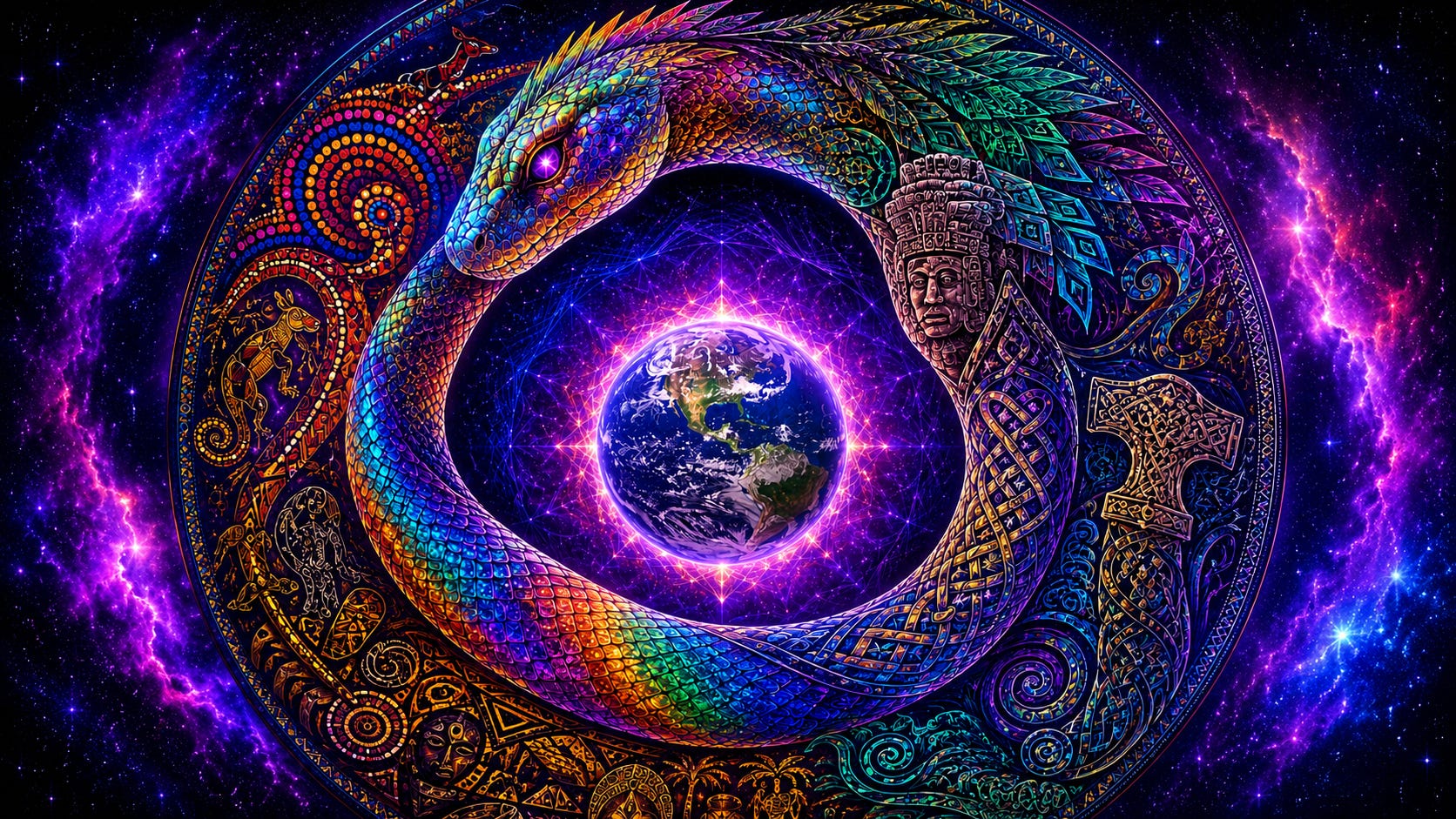
Every culture that ever lived near a crack in the dam drew the same picture. They drew a serpent. They drew it flying. They drew it as a rainbow.
What You’re Actually Seeing
Start with the rainbow itself - not as myth, not as symbol, but as physics.
A rainbow doesn’t exist inside the rain. It doesn’t exist in the sunlight either. It appears at the boundary between them: the zone where light refracts through the transition between rain-dense air and clear air. It is a shear zone phenomenon. It lives at the edge between two different conditions, and it is only visible from a specific vantage point relative to that edge. No one stands inside a rainbow. You can walk toward it your whole life and it will always be the same distance away, because it is not a thing located in space — it is what the boundary looks like from a particular angle.
The Myathe Magick System proposes that the planet’s chronon field — the field governing temporal flow and the opening of genuine creative possibility — is structured along the edges of an icosahedral geometry. Where two faces of that geometry meet, their counter-rotating energy fields produce a shear zone: a boundary layer of elevated turbulence, permeability, and creative potential. This is the riftline. It exists because the geometry exists — not because of weather, not because of season, not because of any local condition. It is a structural feature of the planetary energy field, as permanent as the geometry that produces it. What closes a riftline is entropy, dissonance, and the cessation of maintenance. What keeps one open is resonance — sound, ceremony, practice, the sustained attention of beings who have learned to interact with it. Saturn’s periodic levogyric pressure makes riftlines harder to close at the crests of the novelty wave. But the riftline itself predates all of this. It is the shear zone at the edge. It has always been there.
The dextrogyre field — the phase-locked shell that dams the planetary chronon geometry — moves with the planet above us. The stress fractures in that shell, the riftlines, are in the sky. Chronon energy cracks through from above and reaches downward. The serpent descends. And if you stood beneath one and looked up, you would see something sinuous, luminous, colored, connecting sky to earth, moving in a way that belongs to neither one — something larger than anything that should be in the sky, undulating at the boundary between the phase-locked field and the opening crack in it.
You would see the only thing you could possibly call it.
You would see a rainbow serpent.
The Most Accurate Description Available
Here is the epistemological key to everything that follows: you can only compare something unknown to something you have already seen.
When a person witnesses a phenomenon they have no existing category for, they reach for the nearest available comparison. They are not hallucinating. They are not mythologizing in the pejorative sense — decorating reality with invented creatures. They are doing the most honest thing a witness can do: finding the closest known thing and pointing at it.
People had seen rainbows. People had seen snakes. Then they experienced a riftline — a crack in the chronon dam above them, the shear zone between rotating faces of the planetary geometry expressing itself as visible, luminous, sinuous energy — and they named it what it most resembled. A rainbow snake. Because that is what it looked like.
This is genuinely that simple, and it is also genuinely that profound.
The riftline’s visual properties map cleanly onto both comparisons. It is sinuous — it moves in the flowing, branching, finding-the-path-of-least-resistance manner that riftlines propagate, exactly like slow lightning, exactly like fractal growth through a substrate, exactly like a snake finding its way through terrain. It is iridescent — the boundary between the phase-locked field and the opening crack refracts the energy moving through it in ways that produce spectral color, a luminous multicolored quality that the word rainbow captures better than anything else available. It connects sky to earth — the riftline descends from the dextrogyre field above through the atmospheric column to the surface and below, a vertical axis running from sky to ground. It is associated with creation everywhere it is found — because riftlines are where chronon flow is highest, where the probability field is widest, where genuine novelty enters the world.
It is important to be precise about what the individual mythologies are doing when they add water, rain, and wet seasons to this picture. Those are accurate descriptions of local expression — the riftline’s energy moving through the most resonant available medium in a given geography. Water is an exceptional resonance medium. Atmospheric moisture makes the riftline’s visible signature more dramatic. Rivers and waterholes became riftline maintenance sites because they were the most accessible resonant locations available to the cultures living near them. Each tradition is reporting what it actually experienced in its specific place. None of them is wrong.
But the riftline itself is not made of water. It does not require rain to exist. The vast majority of icosahedral edges run over open ocean — no rivers, no waterholes, no wet season. The riftline is structural, geometric, and permanent. Rain didn’t create it. Resonance maintains it. Entropy closes it. The serpent lives in the sky because the crack is in the sky. Everything else — the waterhole, the wet season emergence, the river system — is what the serpent looked like when it came to ground in a particular place among particular people with particular landscapes available to them.
Every culture that drew the rainbow serpent was being precise. They were doing field observation with the vocabulary available to them. The symbol they produced was not an error. It was a report — and the report was accurate, locally and cosmologically at once.
Every Inhabited Edge
What makes this more than interpretive coincidence is the distribution. The rainbow serpent doesn’t appear in some cultures and not others. It appears wherever people have lived long enough near an active riftline to develop a sustained symbolic relationship with what they were perceiving. And when you lay the icosahedral edge network over a map of rainbow serpent traditions, the overlay is not approximate. It is structural.
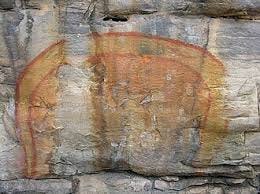
Australia holds the oldest continuous religious tradition on Earth — possibly 65,000 years unbroken — and at its center is the Rainbow Serpent, known by distinct names across more than 250 First Nations language groups on the continent: Yurlunggur to the Yolngu of Arnhem Land, Ngalyod to the Kunwinjku, Wagyl to the Noongar of the southwest, Bolung, Kunmanggur, Goorialla, and dozens more — each name belonging to a specific people with their own relationship to the same phenomenon. The serpent moves between waterholes, shapes the landscape by its passage, rises to fly in the wet season. Each of these traditions encodes the riftline through the landscape most available to it: a continent where water is scarce, where the wet season transforms everything, where waterholes are the most resonant accessible locations for maintenance practice. The serpent sleeping in the mud and rising with the rains is the riftline described through the lens of an arid continent’s relationship with water — an accurate local report of how the riftline expresses itself through the most resonant medium available in that geography. The riftline itself predates the rain. The songlines that crisscross the continent are not roads or trade routes. They are the maintenance paths of the riftline network, walked and sung for tens of thousands of years to keep the shear zones active. Australia sits across multiple icosahedral edges of the southern hemisphere grid, and the songline corridors follow those edges with a precision that the RiVViT mapping is beginning to document. These cultures were not worshipping a creature. They were maintaining a geophysical system and describing what that system looked like through the vocabulary of their landscape. They knew exactly what they were doing.
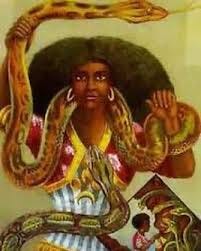
West Africa — specifically the Fon people of Dahomey (modern Benin) and the neighboring Yoruba of southwest Nigeria — sits directly on what the system identifies as the Trade Wind Road corridor. Here the Rainbow Serpent exists as Ayida-Weddo and her counterpart Damballa: the sky serpent and the earth serpent, coiled together before the world was made, carrying the creator goddess in the serpent’s mouth as she shaped the earth. The mountains are where the serpent rested. The rivers are where it moved. The serpent holds the world between earth and sky — and crucially, if it stops circling, if it devours its own tail because the iron that sustains it runs out, the world ends. This is not eschatology. This is a precise description of what happens when riftline maintenance stops: the chronon flow that sustains novelty, creativity, and life itself closes down. The world doesn’t end in fire or flood. It ends in stagnation. In the closed system completing. In the dam becoming permanent.
The Yoruba know the same figure as Oshumare — also a rainbow serpent, also dualistic, also an ouroboros, also responsible for carrying rainfall back into the clouds and maintaining the water cycle’s continuity. Two neighboring cultures, same riftline corridor, independently encoding the same observation as two slightly different names for the same being. Because it was the same being. It was the same riftline.
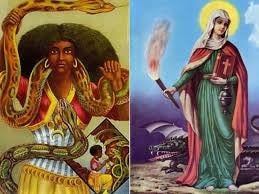
Haiti and the African diaspora received this tradition across the Atlantic — carried by enslaved Africans along the same Trade Wind Road that Ayida-Weddo symbolizes. In Haitian Vodou she remains the rainbow serpent, the iridescent arc between earth and sky, paired with Damballa the white serpent of creation and primordial wisdom. The vévé drawn on the ground to invoke them — two intertwined snakes, the axis mundi, the central post of the temple as the serpent’s body — is a technical diagram of the riftline’s structure. The tradition didn’t merely survive the Middle Passage. It traveled along its own corridor. The Trade Wind Road that carries the Atlantic weather system is the same route the enslaved Africans were forced across, and the serpent goddess who is the rainbow in the sky was already the symbol of that atmospheric corridor. She came home along her own path.
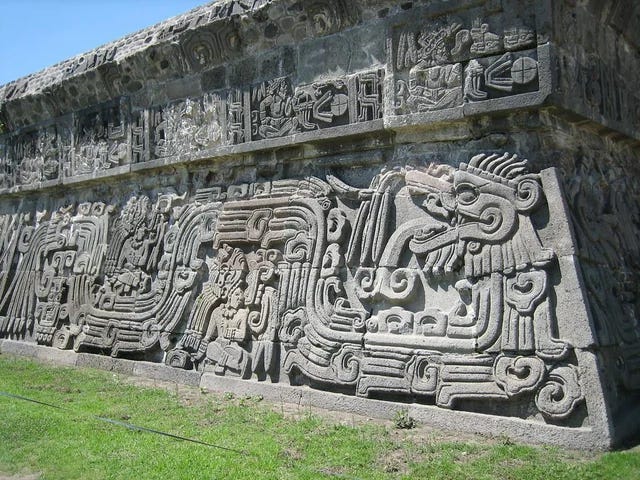
Mesoamerica gives us Quetzalcoatl — the Feathered Serpent, whose worship traces back to the Olmecs around 900 BCE and spread through Teotihuacan, the Maya as Kukulkan, the Toltec, the Aztec. The feathers added to the serpent encode the additional quality the Mesoamerican riftline expressed most clearly: it flies. It is both earth-serpent and sky-bird simultaneously, the full vertical axis of the riftline embodied in one form. At Chichén Itzá, the pyramid of Kukulkan is engineered so that at the spring equinox, the play of light and shadow down the northern staircase produces the appearance of a feathered serpent descending from sky to earth — the riftline made visible in stone, calibrated to the moment when the planetary geometry is most precisely aligned. The Maya communicated with what they called the Vision Serpent through ceremony and entheogenic practice: the riftline accessed through deliberate gnosis induction, the histon wave opened by ritual technology, the serpent arriving as information from beyond the ordinary timeline. These were not hallucinations. These were field observations of the riftline made with the gnosis tools available.
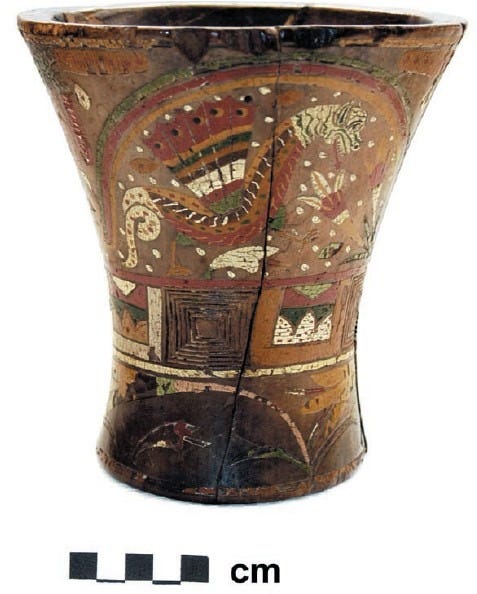
The Inca and Andean peoples give us the Amaru — a gap in most comparative mythology surveys that the system needs to address directly, because it is one of the most precise encodings. The Amaru is a vast double-headed serpent dwelling underground at the bottom of lakes and rivers, representing infinity, knowledge, and cosmic renewal, connecting the earthly world with the spiritual. Its undulating form symbolizes the interconnection between earth and sky. And the Q’eros — descendants of the Inkas who still speak Quechua today — call the rainbow “Amaru of the day” and the Milky Way “Amaru of the night.” The same creature in two different skies. The riftline in its atmospheric expression and in its cosmic expression simultaneously. One being, two registers, one name. The Andean riftline corridor runs through the most seismically active mountain system on Earth, along the BT node cluster where the Inca built Cusco, adjacent to Lake Titicaca where the Amaru dwells. The serpent shaped this landscape. It did. The riftline’s geological expression — the fault systems, the volcanic arc, the river systems radiating from the Andean spine — is what the Amaru’s body traces when it moves. They weren’t making it up. They were mapping.
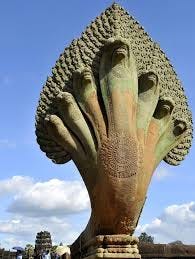
Southeast Asia gives us the Naga — the most widely distributed serpent tradition in Asia, running from India through Cambodia, Thailand, Laos, Vietnam, Indonesia, and beyond. The seven-headed Naga of Cambodian temple iconography, whose seven heads represent the seven races of Naga society, carries a direct symbolic association with the seven colors of the rainbow. Seven-headed, seven-colored — the rainbow encoded as heads rather than as atmospheric arc, the same phenomenon rendered in different visual vocabulary. The Khmer creation myth makes the Naga the ancestor of the Khmer people themselves: an Indian prince marries a Naga princess, their children become the nation. The riftline as genetic origin. You are descended from the shear zone. The Mekong River — running along the Devil’s Sea corridor between nodes — is believed home to powerful Nagas still, and the Naga fireballs of Nong Khai on the Thai-Lao border are reported annually: luminous balls rising from the river during the full moon of Buddhist Lent, attributed to the Naga breathing fire from below. This is not ancient legend. It is a documented recurring phenomenon, observed every year, attributed to the riftline serpent by people who live on the riftline. The shear zone is still expressing itself. People are still watching it and naming it correctly.
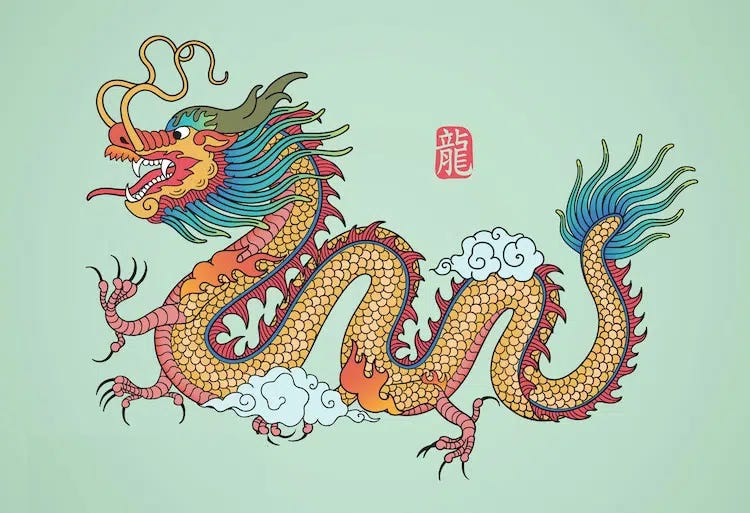
China has the Long — the Chinese dragon, which is emphatically not the Western dragon of chaos and destruction. It is a flying serpent, wingless but airborne, directly associated with rain, rivers, weather, and the sky. Benevolent. Wise. Water-controlling. It carved the river systems by moving through the landscape. It brings the rains. It connects heaven and earth along the Devil’s Sea node and the Pacific edges. The feng shui concept of dragon veins running through the landscape — the invisible channels of energy that skilled practitioners read in the topography — is the riftline network described as the body of the dragon. The dragon vein practitioner and the songline walker are doing the same work in different vocabularies.
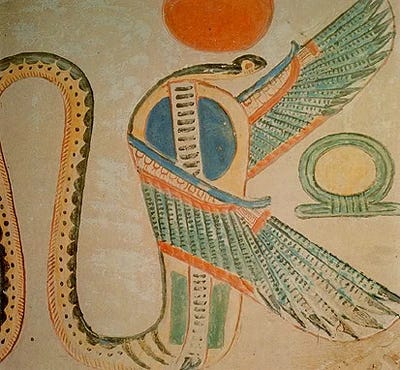
Egypt has the uraeus cobra rising before the pharaoh, Wadjet the flying cobra goddess of Lower Egypt, and Apep the cosmic serpent of the sky that must be defeated each night to allow the sun to rise — the riftline in its suppressed form, the closed system’s nightly reassertion over the probability field, the dam that must be sung open again with each dawn. All on the Algerian Monolith-to-Mohenjo Daro riftline, the Cradle Road, the most historically saturated corridor in the mapping. The Levantine Iron Age Anomaly — a measurable intensification of Earth’s magnetic field concentrated in this region between approximately 1050 and 700 BCE, preserved in the iron oxide of ancient bricks — suggests the Cradle Road was running hot during one of the most generative civilizational periods in recorded history. The serpent was active. The bricks recorded it.
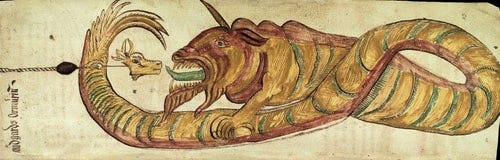
Norse mythology gives us Jörmungandr, the World Serpent, encircling the earth in the ocean along the North Pole-to-Bermuda Triangle North Atlantic corridor. Its release at Ragnarök is the riftline network breaking free of containment entirely — not evil but overwhelming, the dam releasing everything it has held. The world that ends at Ragnarök is specifically the phase-locked world. What comes after is new.
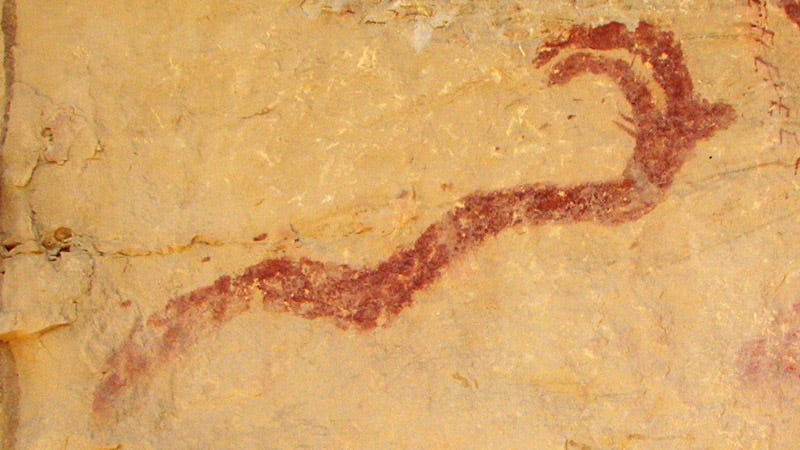
North America holds the Horned Water Serpent across dozens of traditions — the Uktena of the Cherokee, the Piasa of the Mississippian culture, Mishipeshu of the Ojibwe and Anishinaabe, the vast array of flying horned serpents across Plains and Eastern Woodland traditions. The Uktena in particular encodes something precise: a crystalline-scaled serpent with a gemstone in its forehead, whose defeat grants rainmaking, hunting success, and expanded temporal perception to the victor. A crystal in the serpent’s forehead. A chronon lens embedded in the riftline itself, granting the one who approaches it carefully the ability to see more timelines, more possibilities, more of what the probability field contains. The serpent teaches. That is what the riftline does.
The Mississippian Southeastern Ceremonial Complex produced the most extensive serpent iconography in North America — winged serpents depicted with wings to reference the Underwater Spirit’s presence in the night sky as a guardian of the Milky Way, the path of souls. The Milky Way as serpent. The serpent as cosmic corridor. The path of souls running along the same geometry as the riftline network, because chronon flow and the transit of consciousness between states of being are the same phenomenon at different scales.
The Serpent in the Garden
One tradition conspicuously absent from the standard comparative survey of rainbow serpents is the one most immediately familiar to Western readers — the one in Genesis.
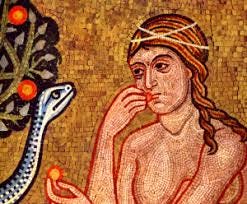
The serpent in the Garden of Eden is at the boundary of the garden. It is in a tree — the axis mundi, the World Tree that connects underground to sky, the same structure that the shaman’s drum travels along in Tengrist cosmology, the same structure the Vodou temple’s central post represents. It offers gnosis: direct experiential knowledge, not received doctrine, not faith, not intermediary — immediate, personal, transformative perception of a wider reality. God’s response is specific: close the high-chronon zone, expel the humans from the garden, place a guard at the gate. The Tree of Life — access to temporal flow, to the full probability field, to the riftline’s creative amplification — is sealed.
This is not a sin narrative. Read without the institutional interpretation layered over it, it is a phase-lock narrative. The serpent was offering what the riftline offers. The punishment was exile from it. The closed system asserting itself against the opening.
The Gnostics read it exactly this way. To the Gnostic traditions — particularly the Ophite and Naassene schools — the serpent in the garden was the good figure, the one trying to restore gnosis access, the one the Demiurge (the false creator god, the builder of the closed system) specifically needed to discredit and suppress. The Naassenes took their name from the Hebrew nachash, serpent. They were the serpent people. They understood what was being encoded in the Genesis narrative and they refused the institutional inversion of its meaning.
Every mystery tradition that preserved the serpent as the carrier of genuine knowledge was encoding the same understanding. The riftline teaches. The serpent that carries gnosis is the riftline that opens the probability field. Every institutional religion that inverted the symbol — encoded the serpent as evil, as tempter, as the enemy of divine order — was performing exactly what the system calls the dextrogyre’s primary operation: capturing the symbol, inverting its meaning, and using the inversion to suppress access to the thing the symbol points at.
The serpent didn’t fall. The access did.
Two Serpents, One Mechanism
The motif that appears most specifically across these traditions — more specific than the single serpent, carrying more structural information — is the twin serpent.
Fon/Dahomey: Ayida-Weddo and Damballa, sky serpent and earth serpent, red half male and blue half female, together holding the world between sky and earth. Inca: the Amaru as a double-headed serpent, one head for each direction of its movement. Java: the two-headed rainbow serpent absorbing water from the North Seas with one head and pouring it into the South Seas with the other. The Caduceus: two serpents intertwined around a central staff. The Chinese Hong is a double-headed rainbow dragon. The DNA double helix: two strands counter-rotating around a shared axis, encoding all biological information in the differential between them.
Two counter-rotating flows producing the shear zone between them. That is the riftline’s mechanism. The mesogyric principle: not one rotation but two, meeting at their shared boundary and generating the creative turbulence that makes novelty possible. The image of two intertwined serpents is not decorative. It is a diagram of the mechanism. The cultures that encoded the twin form were encoding something more precise than the single-serpent cultures. They had seen deeply enough into the phenomenon to perceive its structure — the counter-rotation itself, not just its surface expression.
The twin serpent is the riftline in technical cross-section.
The Serpent That Lives in You
Before considering what this means for magical practice, there is one tradition that deserves particular attention because it locates the rainbow serpent not in the sky, not in the river, not in the geological landscape — but in the body.
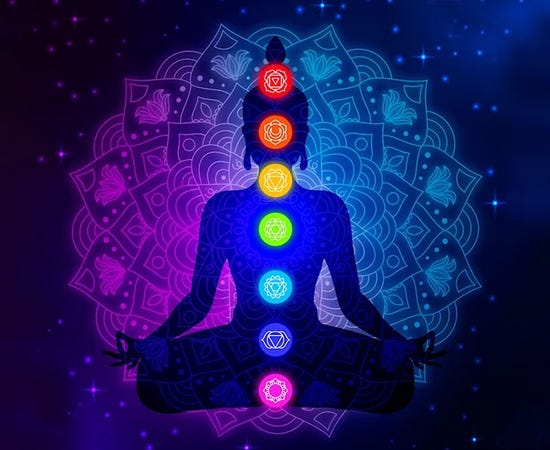
Kundalini is described across Hindu, Tantric, and Tibetan Buddhist traditions as a coiled serpent sleeping at the base of the spine. When activated — through sustained practice, through gnosis induction, through the appropriate conditions — it rises through the chakra system: a luminous, forceful current of energy associated with heat and light and extraordinary states of expanded perception, connecting the base of the body to the crown, earth to sky, the instinctual to the transcendent.
The Myathe Magick System already has the interior riftline concept — the understanding that the same shear zone dynamics that operate in the planetary chronon field operate within individual human consciousness at the boundaries between elemental circuits. Kundalini is the interior riftline by another name. The serpent coiled at the base is the riftline in its dormant state — present, structural, waiting for the resonance conditions that will activate it. The risen kundalini is the interior shear zone fully active, the personal probability field opened, the individual chronon permeability restored. The same geometry. The same mechanism. The same serpent, at personal scale.
The rainbow body in Tibetan Buddhist tradition — the achievement, reported and documented in the tradition, of complete dissolution into rainbow light at death — is the interior riftline completing its full circuit. You become what you were always perceiving in the sky. The chakra system’s seven colors ascending to the crown are the spectrum of the rainbow ascending from earth to sky. The eight chakras of some traditions — adding the transpersonal point above the crown — are the seven colors plus the eighth, the one beyond ordinary perception.
Which brings us to the most direct connection between the rainbow serpent tradition and contemporary Western magical practice.
Octarine: The Color the Serpent Bites You Into
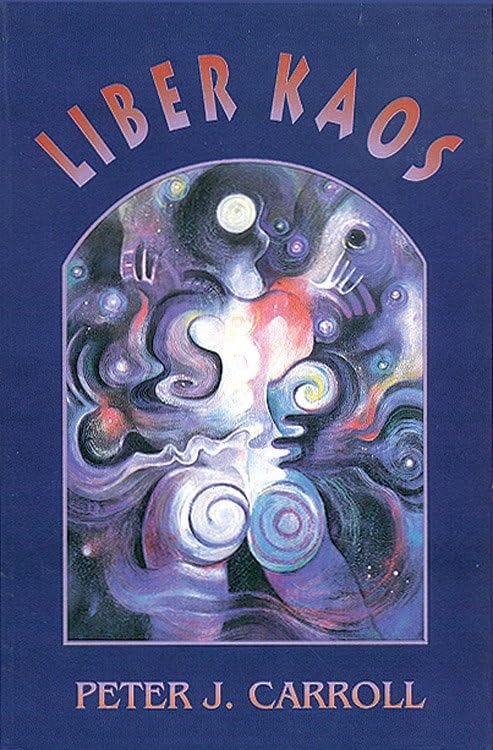
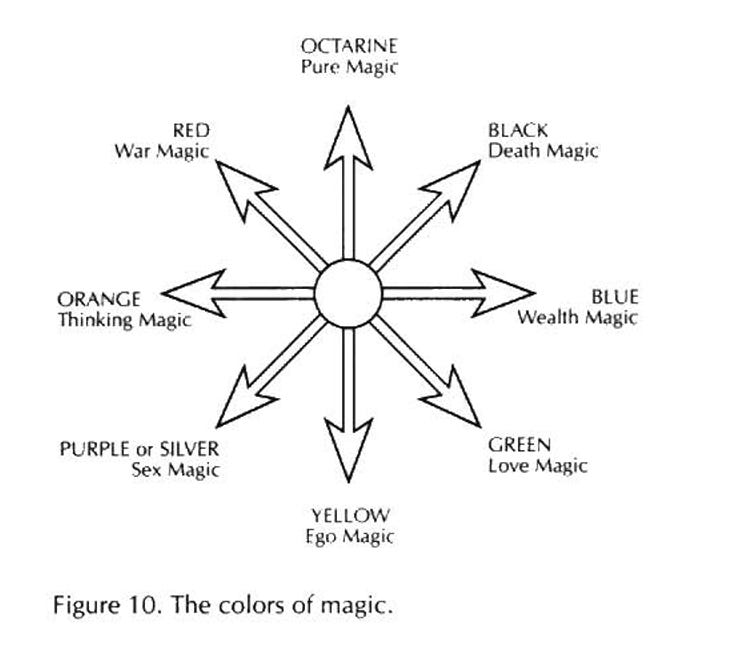
Peter Carroll’s Liber Kaos (1992) presents a system of eight types of magic, each attributed a color corresponding to different instinctual drives and modes of magical working. Seven correspond to the seven classical planets. The eighth — Octarine — corresponds to Uranus, and Carroll explicitly notes it follows Terry Pratchett’s hypothesis: the eighth color of the spectrum, the color of magic itself, visible only in gnosis states, perceived differently by each magician but consistently described as electric, luminous, beyond the normal visible range.
Carroll writes, directly:
”The awakening of the octarine power is sometimes known as ‘being bitten by the serpent.’”
And separately, on the octarine god-form:
”Alternatively the magician may wish to formulate a magician god form on a purely idiosyncratic basis, in which case the symbolism of the serpent and the planet Uranus often prove useful starting points.”
Carroll did not need the riftline vocabulary to encode the connection. The serpent is his symbol for the awakening of the octarine power — the moment the eighth color becomes perceptible, the moment the full spectrum opens into something beyond the ordinary visual field, the moment the magician’s probability field widens beyond the phase-lock’s baseline. Seven visible colors plus the one you can only see in gnosis. Seven chakras plus the one above the crown. Seven planetary magics plus the one that governs magic itself.
The rainbow serpent seen at maximum riftline intensity would be octarine. Not a metaphor — a description. The boundary phenomenon that all these cultures were observing, at its most fully expressed, produces a perceptual experience that doesn’t fit in the ordinary visual spectrum. It bites you into the eighth color. It bites you into the riftline’s full aperture. That is what “being bitten by the serpent” means in Carroll’s system, and it is the same event that a Yolngu elder, a Vodou practitioner, the Maya king at the top of the pyramid, and the Andean shaman at the lake were describing in their own vocabularies.
The chaos star’s eight rays, each a different color of magic — the observation that this is a rainbow encoded as a radiant diagram — holds. The spectrum expressed as direction rather than arc. The riftline’s full range of expression mapped as points on a star. And at the center, the shear zone itself: the void, the Chaos, the opening from which all eight colors radiate.
The Ouroboros Is a Warning
In its most archaic forms across multiple traditions — Egyptian Mehen, Fon Aido Hwedo, Yoruba Oshumare, early Quetzalcoatl — the serpent doesn’t just live on the riftline. It holds the world together by circling it. And if it stops — if it devours its own tail because the iron that sustains it runs out, if it loses the strength to keep circling — the world ends.
Not in catastrophe. Not in fire. The world ends because the serpent’s circulation was what was keeping it alive.
The ouroboros is not primarily a symbol of cyclicality, though it encodes that. It is a warning about riftline maintenance. The serpent circling the world is the riftline network in mesogyric equilibrium — all edges connected, all nodes feeding the next, the planetary chronon field as a self-sustaining loop. The serpent eating its own tail is what happens when maintenance stops: the network begins to consume itself, chronon flow closes inward rather than circulating outward, the closed system completes. The world doesn’t end dramatically. It ends the way a river ends when you dam all its tributaries: slowly, silently, as the flow stops and what remains stagnates.
The maintenance traditions understood this. A Yolngu songline walker singing the country wasn’t performing a ritual for its own sake. They were keeping the serpent moving. The Dogon’s 60-year Sigui ceremony wasn’t astronomical record-keeping. It was a pulse sent to the riftline to confirm it was still open. The Naga fireballs rising from the Mekong each year are not a curiosity. They are the serpent breathing. Someone on that river bank is watching it and knowing that the world remains alive for another year.
This is the stakes of riftline maintenance: not spiritual achievement, not personal enlightenment, but the continued circulation of the creative possibility that makes novelty, life, and genuine human experience possible. Every person who has ever maintained a riftline — by singing, by ceremony, by artistic practice, by gnosis, by the simple act of going where they are called and making sound there — has been keeping the serpent moving.
The Transmission the Symbol Carries
The serpent symbol survives amnesia. This is its most remarkable property and the deepest evidence of what it points at.
You lose the ability to describe what a riftline is. The framework dissolves, the vocabulary disappears, the cosmological structure that made the experience legible becomes unavailable. But you still have the rainbow in the sky — the closest visible thing to what you were perceiving. The symbol carries the transmission forward through the closure. It doesn’t need the framework to survive. It needs only to be pointed at, maintained, handed from one person to the next with the instruction: this matters. Keep looking at it.
Every mystery tradition that preserved the serpent as the carrier of genuine knowledge was doing exactly this. Blavatsky saw the global convergence in the 19th century and named it the Archaic Doctrine — a primal wisdom tradition encoded in the serpent symbol across all cultures, predating the institutional religions that suppressed it. Grant mapped the Typhonian current in the 20th century and connected Tiamat to Sirius to kundalini to Lovecraft, assembling the same pieces from the Western esoteric lineage. Carroll encoded the serpent’s bite as the initiation into octarine magic, the eighth color, the gnosis that makes all other magic possible.
None of them needed to agree with each other. None of them needed to be working from the same framework. The symbol was carrying the same content through all of them because it has always been pointing at the same thing.
The riftline finds its practitioner. The serpent finds its name. And everywhere it is named, it is named the same way: as the creative force that flows, that undulates, that connects earth to sky, that brings the rains and the rivers and the possibility of life. As the thing that makes the world possible by moving through it. As the thing whose continued movement is the condition for everything else.
You look up at the shear zone. The crack in the sky is raining down chronon experience — information from beyond the phase-lock, novelty from the undamaged probability field, the signal that has always been trying to reach you through the sealed dam.
It is sinuous. It is luminous. It is colored with every color simultaneously, and something beyond color at its most open point.
You call it what it looks like. You call it what the people beside you call it. You call it what everyone who ever stood in this place and looked up has always called it.
You call it the rainbow serpent.
You call it correctly.
The Myathe Magick System maps the icosahedral riftline network against cultural, geographic, and archaeological data through the RiVViT globe visualization, publicly accessible at [myathemagick.com]. The full theoretical framework is documented in the Myathe Magick System document, currently in active development.